


Cannabis Vaping, Smoking, and Dual Use and the Onset of Respiratory Symptoms Among U.S. Young Adults
Source / Quelle: https://www.ajpmonline.org/article/S0749-3797(26)00164-9/abstract Abstract Introduction Many young adults vape and smoke cannabis, but it remains unclear whether dual use increases the risk of respiratory problems. Methods This study analyzed the national longitudinal Population Assessment of Tobacco and Health Study. The sample included 5,211 young adults (aged 18–24 years) without prior respiratory or pulmonary conditions at Wave 6 who completed Wave 7. Multivariable logistic regressions examined longitudinal associations between baseline cannabis vaping and smoking and functionally important respiratory symptoms at follow-up, controlling for sociodemographics, other substance use, health conditions, obesity, and cannabis use frequency. Data were collected between 2021 and 2023 and analyzed in 2025. Results At baseline, 18.8% of young adults reported past 30-day cannabis vaping or smoking: 2.1% vaped only, 11.3% smoked only, and 5.3% both vaped and smoked. Overall, 2
14. August 2026

Human Metabolites of CBD: A Review on Their Formation, Biological Activity, and Relevance in Therapy
Source / Quelle: https://pmc.ncbi.nlm.nih.gov/articles/PMC5576600/ Human Metabolites of Cannabidiol: A Review on Their Formation, Biological Activity, and Relevance in Therapy Abstract Cannabidiol (CBD), the main nonpsychoactive constituent of Cannabis sativa, has shown a wide range of therapeutically promising pharmacological effects either as a sole drug or in combination with other drugs in adjunctive therapy. However, the targets involved in the therapeutic effects of CBD appear to be elusive. Furthermore, scarce information is available on the biological activity of its human metabolites which, when formed in pharmacologically relevant concentration, might contribute to or even account for the observed therapeutic effects. The present overview summarizes our current knowledge on the pharmacokinetics and metabolic fate of CBD in humans, reviews studies on the biological activity of CBD metabolites either in vitro or in vivo, and discusses relevant drug–drug interactions. To facilit
13. August 2026
Harnessing Cannabinoids to Target Inflammation and Oxidative Stress in Translational Medicine
Source / Quelle: https://jintb.org/index.php/jintb/article/view/30 Abstract Inflammation and oxidative stress contribute to numerous human diseases. Conventional therapies provide symptomatic relief but fail to address molecular dysfunction. Cannabinoids emerge as promising modulators of these processes, influencing CB1/2 receptor signaling, regulating NF-κB and Nrf2 pathways, and reactive oxygen species production. Preclinical studies demonstrate them to reduce cytokine release, limit oxidative damage, and protect tissue integrity across multiple systems. Early clinical investigations suggest potential benefits in pain management, neurodegeneration, and metabolic conditions. Future research focusing on minor and synthetic cannabinoids, biomarker-guided dosing, and combination therapies can enhance translational success, but regulatory and safety considerations remain critical. By bridging mechanistic insights with clinical application, cannabinoids hold significant potential to addres
13. August 2026

Cannabigerol (CBG) Modulates Neutrophil Activity and Ameliorates Rheumatoid Arthritis Pathogenesis
Source / Quelle: https://www.mdpi.com/1424-8247/19/4/560 Abstract Background/Objectives: Rheumatoid arthritis (RA) is a chronic, inflammatory, autoimmune disease that primarily affects the joints. Current treatments aim to relieve pain and limit joint damage; however, many are associated with significant side effects or high costs. Neutrophils play a critical role in RA development and progression by driving synovial inflammation and tissue damage, yet no approved therapies directly target neutrophil-mediated pathogenic mechanisms. Cannabinoids have demonstrated anti-inflammatory potential. Although cannabinoids have been studied in RA, the direct modulation of neutrophil-driven mechanisms by purified CBG has not been systematically addressed. To harness the cannabinoid potential, we investigated the effects of the purified cannabinoid Cannabigerol (CBG) on neutrophil-mediated immune responses in RA. Methods: We assessed the effects of CBG on human blood isolated neutrophil cytokine se
13. August 2026
Tetrahydrocannabinol/cannabidiol in the treatment of restless legs syndrome
Source / Quelle: https://link.springer.com/article/10.1007/s00415-026-13975-y Abstract Background Dopamine agonists were previously considered the first-line treatment for Restless Legs Syndrome (RLS); however, α2δ ligands are now recommended to prevent augmentation. As cannabinoids inhibit glutamate release in the striatum, they may represent an effective therapeutic option for RLS. Objective Evaluate the efficacy of 2.7 mg Δ9Tetrahyedrocannabinol/2.5 mg Cannabidiol (2.7mgTHC/2.5mgCBD) in RLS. Methods This is an exploratory, prospective, 3-month open-label trial. At baseline, patients underwent blood testing, respiratory polygraphy, and a 14-day actigraphy. Treatment was initiated at baseline, with dose titration at week 4 if required. The Expanded Disability Status Scale (EDSS), Epworth Sleepiness Scale (ESS), International Restless Legs Syndrome Rating Scale (IRLS), Modified Ashworth Scale, and EQ-5D were assessed at baseline and at weeks 4 and 12. The 14-day actigraphy was repeated
12. August 2026
CBG and CBC Induce Lung Cancer Cell Death and Apoptosis—Contribution of PPARα to Cannabigerol Effect
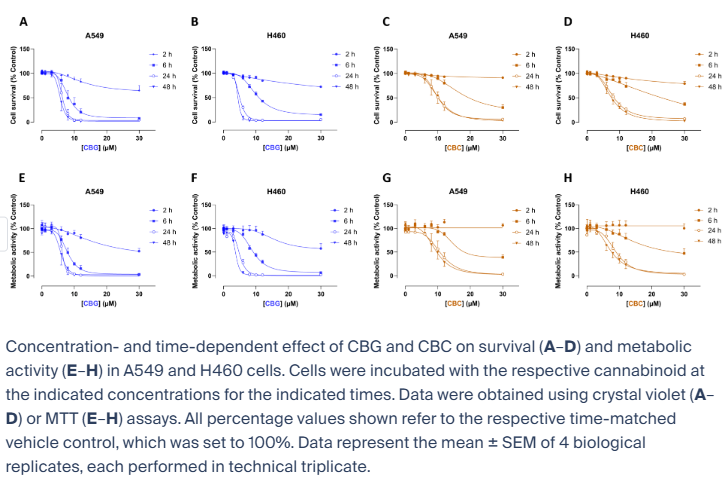
Source / Quelle: https://www.mdpi.com/2076-3921/15/6/754 Abstract Cannabinoids are potential anticancer agents for the add-on treatment of malignant tumors. Here, the effects of the previously less-explored non-psychoactive phytocannabinoids cannabigerol (CBG) and cannabichromene (CBC) on survival, apoptosis, and mitochondrial function were assessed in A549 and H460 lung cancer cells. CBG and CBC triggered concentration-dependent cell death, autophagy, and mitochondrial apoptosis in both cell lines, with apoptosis indicated by Annexin V staining, activation of caspase-8, -9, and -3/7, loss of mitochondrial membrane potential, and elevated cytosolic levels of mitochondrial cytochrome c. CBG also upregulated ATF4, a stress-responsive transcription factor involved in autophagy and apoptotic signaling, and enhanced PARP cleavage. Both cannabinoids increased mitochondrial superoxide formation and reduced the mitochondrial oxygen consumption rate, with CBG additionally decreasing NDUFB8, a s
12. August 2026