

Antiproliferative Effects of Cannabinoids and Cisplatin in Cervical Cancer Cells
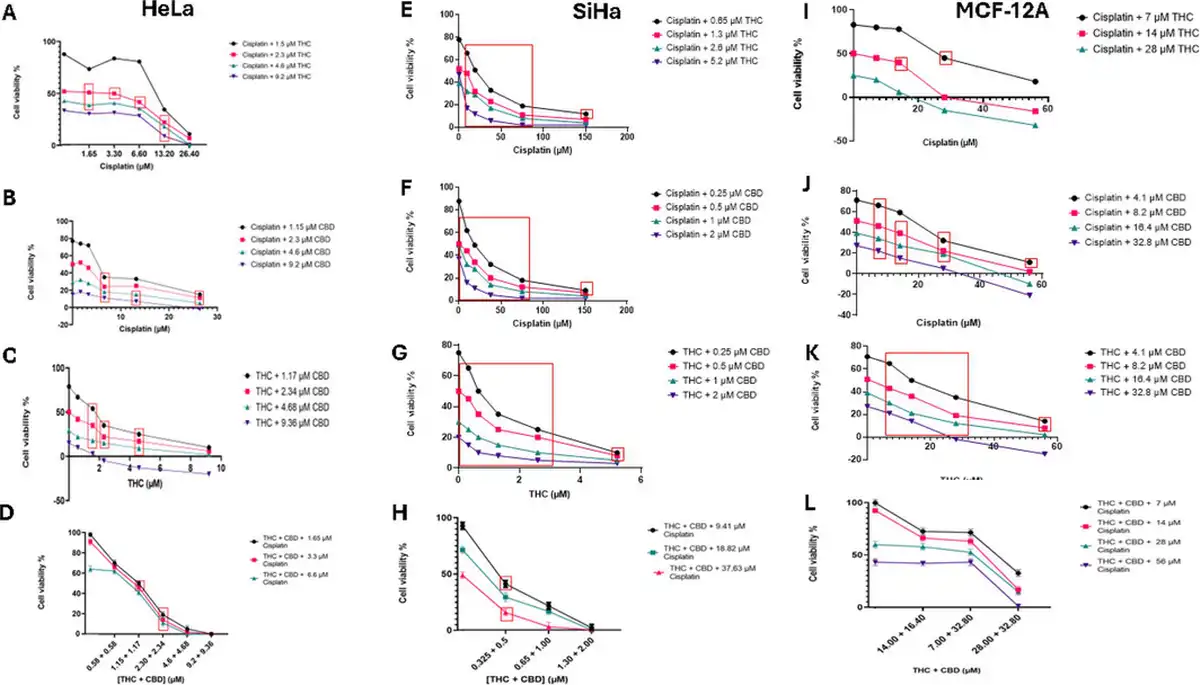
Source / Quelle: https://www.ovid.com/journals/canrep/fulltext/10.1002/cnr2.70561~antiproliferative-effects-of-cannabinoids-and-cisplatin-in Introduction Cervical cancer remains a leading cause of cancer-related mortality among women globally, particularly in low- and middle-income countries. Cisplatin, a standard chemotherapeutic agent, is limited by severe toxicities and chemoresistance. This study aimed to assess the effects of cisplatin in combination with phytocannabinoids, Δ9-tetrahydrocannabinol (THC) and cannabidiol (CBD) on cell proliferation, morphology, cell cycle progression, cell death, and DNA damage. Methods Synergistic interactions between THC, CBD, and cisplatin were assessed in HeLa, SiHa, and MCF-12A cells using the checkerboard assay and SRB assay. Cell morphology, cell cycle progression, apoptosis induction, autophagic activity, and DNA repair gene expression were evaluated using various techniques. Results The THC–CBD–cisplatin combination exhibited the strongest
12. August 2026
CBD-Induced Tumor Cell Death: Molecular Mechanisms and Translational Perspectives in Cancer Therapy
Source / Quelle: https://www.tandfonline.com/doi/full/10.2147/DDDT.S597740 Abstract Background Cannabidiol (CBD), a major non-psychoactive phytocannabinoid derived from Cannabis sativa, has attracted increasing attention as a potential anticancer agent because of its pleiotropic biological activities and favorable safety profile. However, the mechanisms by which CBD regulates tumor cell death and their therapeutic relevance remain incompletely understood. Methods and Results This review summarizes current evidence on the molecular mechanisms by which CBD regulates tumor cell death across different cancer models. Available studies indicate that CBD exerts antitumor effects through multi-target and multi-pathway mechanisms involving oxidative stress, mitochondrial dysfunction, endoplasmic reticulum stress, calcium homeostasis imbalance, and modulation of signaling networks such as PI3K/Akt/mTOR, MAPK, NF-κB, and PPARγ. Through these interconnected processes, CBD can induce apoptosis, aut
12. August 2026
Cannabis surpasses tobacco among pregnant women: national trends and predictors of use in the U.S.
Source / Quelle: https://www.sciencedirect.com/science/article/abs/pii/S0306460326001504?via%3Dihub Abstract Background Rapid cannabis legalization in the United States has heightened concern about prenatal exposure as social acceptance increases. While tobacco use during pregnancy has steadily declined, emerging evidence suggests cannabis use may be rising. We examined national trends in tobacco-only use, cannabis-only use, and co-use among pregnant individuals from 2015 to 2023 and identified associated sociodemographic factors. Methods We analyzed nationally representative 2015–2023 National Survey on Drug Use and Health data restricted to pregnant women ages 15–44 (N = 6,099). Outcomes were self-reported past-30-day tobacco-only use, cannabis-only use, and co-use. Weighted prevalence was estimated for 2015–2019, 2020, and 2021–2023. Multivariable logistic regressions for 2015–2019 and 2021–2023 assessed predictors relative to non-use, reporting adjusted odds ratios and average marg
12. August 2026