

The Effect of Cannabidiol on Cancer-Pathway Genes in Doxorubicin-Sensitive and Resistant Breast Cancer Cells

Source / Quelle: https://www.mdpi.com/1424-8247/19/4/615
Abstract
Purpose: Cannabidiol (CBD) is a primary bioactive, non-intoxicating cannabinoid found in the cannabis plant. Studies have shown that CBD causes anticancer activity by inhibiting the expression of growth factors and inducing apoptosis, leading to cell cycle arrest. In this study, we aimed to determine how CBD influences the expression of genes that affect cancer pathways in doxorubicin-sensitive (MCF-7) and doxorubicin-resistant (MCF-7/Adr) breast cancer cells. Materials and Methods: IC50 concentrations of CBD in MCF-7 and MCF-7/Adr cell lines were determined by the MTT cell cytotoxicity assay. RNA isolation and subsequent cDNA synthesis were performed for qPCR experiments with the determined IC50 values. The effects of CBD on the cell cycle and apoptosis were studied using flow cytometry. IC50 values of CBD were determined in MCF-7 and MCF-7/Adr breast cancer cell lines at eight different concentrations and at three different incubation periods (24 h, 48 h, and 72 h) with different doses. RT-qPCR was used to investigate the molecular mechanisms underlying the expression of genes involved in cancer pathway analysis. Results: Treatment with CBD at concentrations of 17.57 μM (MCF-7) and 11.41 μM (MCF-7/Adr) for 48 h decreased colony formation, induced apoptosis, and inhibited cell invasion in both cell lines. In addition, we observed significant alterations of angiogenesis, apoptosis, cell cycle, cellular senescence, DNA damage and repair, epithelial-to-mesenchymal transition, hypoxia, metabolism, telomeres, and telomerase in both cell lines. Conclusions: Our research indicates that CBD could be an effective natural bioactive compound for breast cancer treatment, inhibiting tumor cell proliferation and inducing apoptosis.
Keywords:
cannabidiol; apoptosis; breast cancer; doxorubicin resistance
1. Introduction
Breast cancer (BC) is the most common malignancy in women worldwide. It is the second leading cause of cancer-related deaths. The disease is complicated by genetic and phenotypic heterogeneity, meaning that each patient requires a unique treatment. The gene expression profile and the presence or absence of surface receptors significantly impact the understanding of the biological heterogeneity of breast cancer, which categorizes them into four molecular subtypes (luminal A, luminal B, HER2, and triple-negative BC (TNBC)) [1]. Patients with breast cancer are classified as estrogen receptor α (ERα) positive or negative depending on the ERα status of the tumor, and 70% of patients are ERα positive, meaning that the growth and development of their tumors depend on estrogen [2].
There is a significant difference in chemotherapy sensitivity between Estrogen Receptor-Alpha-Negative and Estrogen Receptor-Alpha-Positive breast tumors. In patients with ER+/PR+ breast cancer, endocrine hormone therapies are commonly used as primary systemic therapies, complementing surgery. These include ovarian function suppression, selective estrogen receptor modulators, selective estrogen receptor downregulators, and aromatase inhibitors [3]. Chemotherapy, including doxorubicin/Adriamycin, paclitaxel, docetaxel, cyclophosphamide, and carboplatin, alone or in combination, is commonly used for neoadjuvant or adjuvant treatment of breast cancer, to downstage tumors or as a standard-of-care regimen for aggressive and early stage disease [4].
Despite significant advances in cancer treatment, doxorubicin, a drug with high therapeutic efficacy, is still in use for the treatment of breast cancer and other cancers.
Doxorubicin (DXR) is a chemotherapeutic drug, part of the anthracycline family, which is used to treat breast cancer. However, it has been shown that DXR can induce drug resistance and even tumor growth, resulting in poor patient prognosis and survival Although various mechanisms have been investigated, DXR resistance remains a significant and unresolved problem in the treatment of cancer patients. Studies have reported that the interaction between signaling pathways may promote DXR resistance by inducing proliferation, promoting cell cycle progression, and inhibiting apoptosis [5]. In 1986, Batist et al. established the MCF-7/Adr adriamycin-resistant cell line by incubating MCF-7 cells with increasing concentrations of the anthracycline antibiotic [6]. In cancer research, MCF-7/Adr cells are widely used as a model of multidrug-resistant MCF-7 cells [7]. Even though there has been a lot of research on doxorubicin resistance in breast cancer, we still do not know all the details about the specific genes and pathways involved in this process.
The plant Cannabis sativa has been used medicinally for several thousand years. More than 540 metabolites contribute to its therapeutic properties, and CBD is one of the key phytocannabinoids. Research has indicated that CBD has a broad range of therapeutic effects and is linked to cancer treatment [8]. Several studies have investigated the effects of CBD on breast cancer models, including MCF-7 cells. For example, Schoeman et al. showed that CBD decreases the viability of MCF-7 breast cancer cells and induces apoptosis in a dose-dependent manner [9]. In addition, in vivo studies support the antitumor potential of CBD in breast cancer models, highlighting its ability to modulate tumour growth and associated molecular pathways. These findings support the relevance of CBD as a potential therapeutic agent in breast cancer and provide a basis for further investigation [10]. These encompass the suppression of tumor cell proliferation and metastasis, as well as the initiation of autophagy or apoptosis. CBD can alter the tumor microenvironment, reducing cytokine secretion from cancer cells. CBD has influence on this process through cannabinoid receptors, mainly cannabinoid receptor 1 (CB1) and cannabinoid receptor 2 (CB2), as well as other signaling pathways including transient receptor potential vanilloid 1 (TRPV1), G protein-coupled receptor 55 (GPR55), and peroxisome proliferator-activated receptor gamma (PPARγ). CBD can alter the tumor microenvironment, reducing cytokine secretion from cancer cells [11]. Doxorubicin resistance is a significant barrier to effective breast cancer treatment; examining the therapeutic potential of CBD in both sensitive and resistant cell models is crucial. In this study, we aimed to determine the therapeutic efficacy of CBD that affects cancer pathways in doxorubicin-sensitive (MCF-7) and doxorubicin-resistant (MCF-7/Adr) breast cancer cells and to evaluate its effects on cancer-related pathways associated with drug resistance.
2. Results
2.1. Cannabidiol Inhibits the Proliferation of Breast Cancer Cells
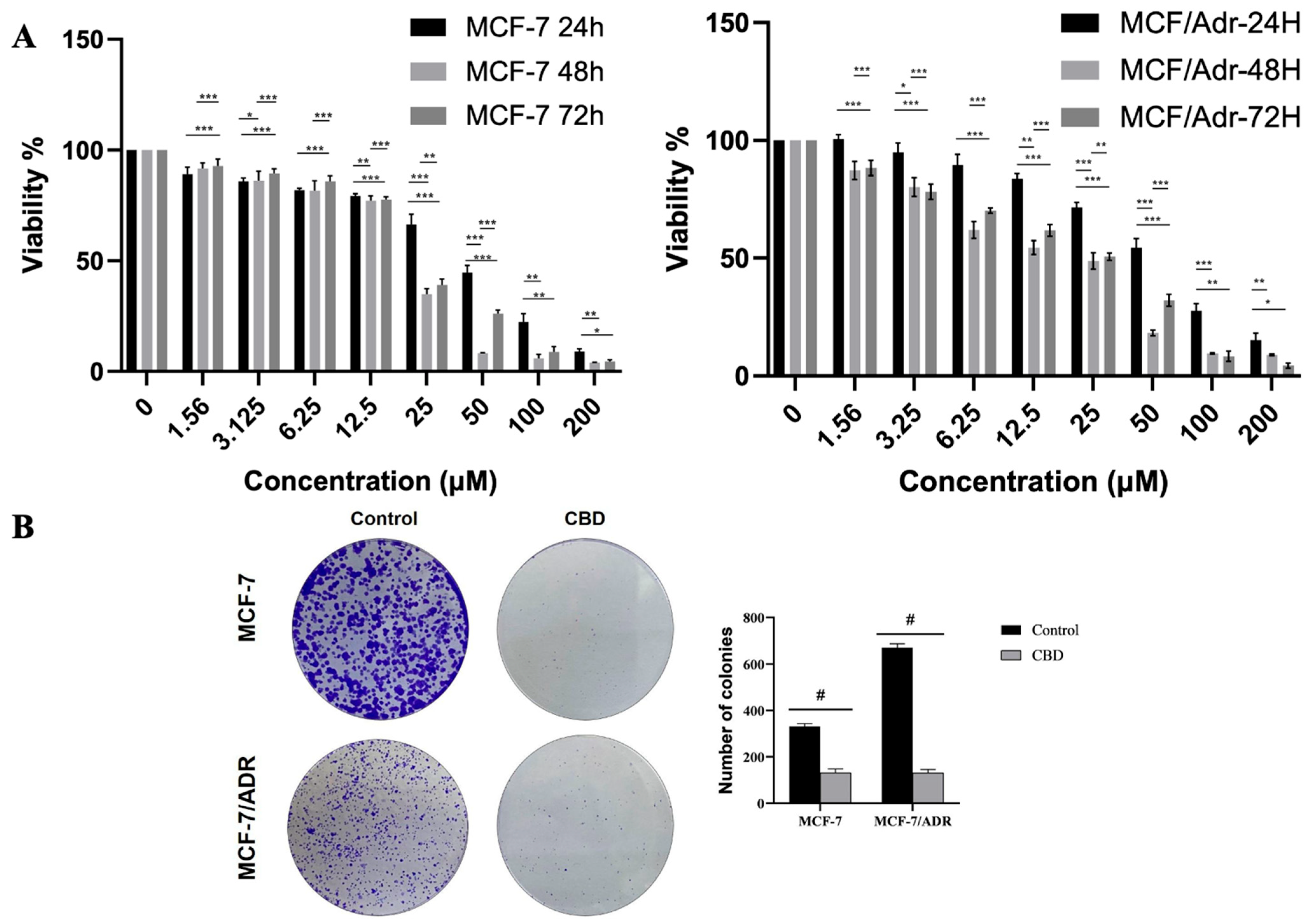
The effects of CBD on the viability of MCF-7 and MCF-7/Adr cells were evaluated using the MTT assay (Figure 1). As shown in Figure 1A,B, CBD treatment inhibited cell viability in both MCF-7 and MCF-7/Adr cell lines in a dose- and time-dependent manner. The IC50 values of CBD in MCF-7 cells after 24, 48, and 72 h of incubation were determined to be 30.37 ± 1.05 µM, 17.57 ± 1.56 µM, and 20.48 ± 1.25 µM, respectively. The IC50 values of CBD in MCF-7/Adr cells after 24, 48, and 72 h of incubation were determined to be 38.97 ± 0.12 µM, 11.41 ± 1.69 µM, and 16.68 ± 1.63 µM, respectively. These findings indicate that CBD exerted dose- and time-dependent inhibition in both cell lines. According to the colony formation capacity analysis, the number of colonies in cells treated with CBD at 17.57 μM (MCF-7) and 11.41 μM (MCF-7/Adr) decreased significantly compared with the control group (p < 0.0001 #).To determine the selectivity of cannabidiol (CBD) toward cancer cells, the same concentrations were applied to CCD-1072Sk normal fibroblast cells. The IC50 value in CCD-1072Sk cells was calculated as 45.36 ± 1.42. The selectivity index (SI), calculated as the ratio of the IC50 value in normal CCD-1072Sk cells to that in cancer cells, was determined to be 2.58, indicating a markedly higher sensitivity of cancer cells to CBD treatment.
2.2. CBD Induces Apoptotic Cell Death and Suppresses the Invasion of Breast Cancer Cells
FITC Annexin V analysis results showed an increase in the number of apoptotic cells in breast cancer cells treated with CBD. The rates of early and late apoptotic cells in MCF-7 cells treated with 17.57 μM CBD were 5.48% and 5.23%, respectively. On the other hand, in MCF-7/Adr cells treated with 11.41 μM CBD, the percentages of early and late apoptotic cells were 4.21% and 1.06%, respectively. CBD increases the number of apoptotic cells in MCF-7 compared with MCF-7/Adr. These results suggested that CBD triggered both early and late-stage apoptosis in breast cancer cells (p < 0.0001) (Figure 2A). Additionally, MCF-7/Adr cells treated with 11.41 μM CBD led to a significant increase in the number of necrotic cells compared to 17.57 μM CBD-treated MCF-7 cells (p < 0.0001) (Figure 2A).
[...]