

Chronic oral cannabidiol delays seizure onset and reduces seizure burden in a mouse model of CLN2 disease
Source / Quelle: https://journals.plos.org/plosone/article?id=10.1371/journal.pone.0337880

Abstract
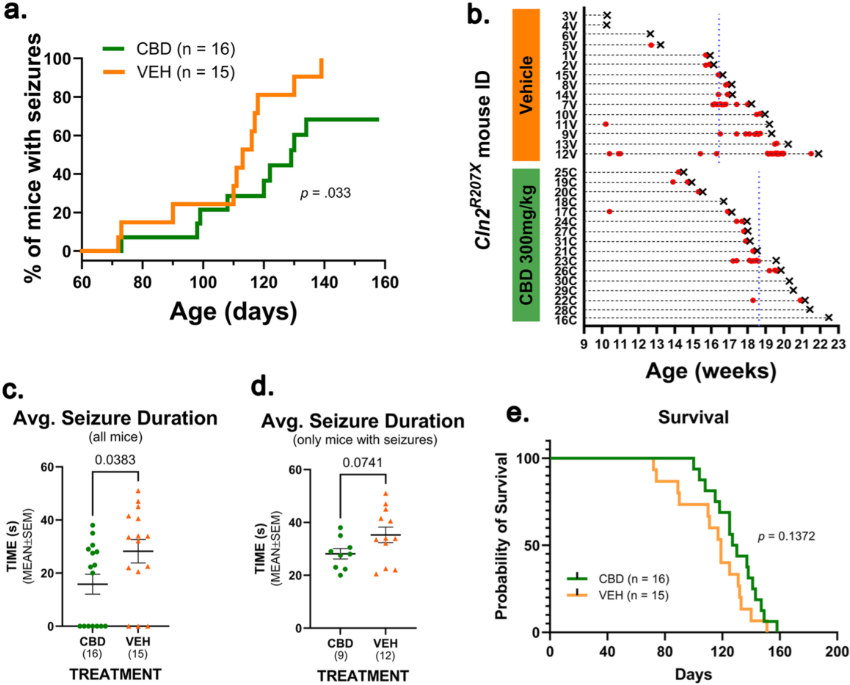
A growing body of literature describes the anti-inflammatory, neuroprotective, and anti-epileptic properties of the cannabis sativa constituent cannabidiol, suggesting that it might play a useful role in the treatment of neurodegenerative diseases. Late infantile neuronal ceroid lipofuscinosis (CLN2 disease) is a rare pediatric neurodegenerative disorder resulting from an inherited dysfunction of the lysosome. CLN2 disease, and its representative animal models, display neuroimmune response, neuroinflammation, neurodegeneration, and epileptic seizures, and these symptoms are all touted as potential targets of cannabidiol therapeutic benefit. Here, we treated a valid model of CLN2 disease with long-term daily cannabidiol (300 mg/kg) from 1 month of age until disease end stage and evaluated epileptic seizures, lifespan, and markers of neuroimmune response. Chronic cannabidiol treatment significantly delayed or fully eliminated seizures in CLN2 model mice compared to those treated with vehicle only, and the treatment led to a non-significant extension of lifespan. These effects occurred in the absence of any therapeutic benefit to physiological markers of disease such as GFAP, CD68, and cytokine/chemokine reactivity. Taken together, we show that chronic treatment with cannabidiol confers significant anti-seizure benefit to the mouse model of CLN2 disease, and that it does not appear to do so by altering the inflammatory and neuroimmune markers traditionally used to track CLN2 disease progression.
Introduction
Mutations in the TPP1/CLN2 gene encoding the lysosomal enzyme tripeptidyl peptidase 1 (TPP1) cause CLN2 disease or late infantile Neuronal Ceroid Lipofuscinosis, previously referred to as classical late infantile Batten disease [1]. Children with CLN2 disease experience developmental delay, epilepsy, and early death [2,3]. There is currently one FDA-approved therapy for CLN2 disease, which involves regularly supplying recombinant TPP1 enzyme into the lateral ventricle via a chronic port. This treatment (Brineura enzyme replacement therapy) slows the progression of disease and improves some clinical symptoms [4]. It must be supplied for the life of the patient and is administered in two-week increments. Despite some benefit, enzyme replacement therapy does not completely prevent or reverse progression of the disease, so most patients continue to have impairing neurological symptoms. The need for developing novel treatments for CLN2 disease is clear.
In recent years, purified cannabidiol (CBD; drug name Epidiolex) from the cannabis sativa plant has been approved for the treatment of seizures in children with Dravet Syndrome, Lennox-Gastaut Syndrome, and Tuberous Sclerosis Complex. Addition of CBD to existing anti-seizure drug regimens leads to an additional reduction in seizure frequency in children with these conditions [5–7]. Anecdotally, some families of NCL patients report that various cannabis products help control their children’s seizures. However, there have been no controlled studies in children with CLN2 disease or animal models of the disease. There are many reports of other effects of CBD in animal models of disease. Germane to CLN2, it has been shown that CBD may have anti-inflammatory, neuroimmunomodulatory, and neuroprotective effects [8–12]. Our own work evaluated the effects of chronic CBD therapy in the mouse model (Cln1-/-) of a related disorder, CLN1 disease/infantile NCL, previously referred to as infantile Batten disease. We showed that chronic oral administration of CBD reduced the neuroimmune response in areas of the thalamus and cortex, well-established as being severely affected regions of the CNS [13,14]. CBD appears to have limited neuroprotective effects as measured by neuron count and cortical thickness, however these measures were taken at CLN1 disease end-stage. There also appeared to be no effect of CBD on seizure frequency in the Cln1-/- mouse. Importantly, based on existing literature, the dose of CBD that was administered to the Cln1-/- mouse was relatively low compared to those used in other disorders [11,15–17]. It is our belief that a higher dose of CBD may yield a more positive therapeutic benefit.
A mouse model of CLN2 disease harboring the Cln2R207X mutation (henceforth referred to as “CLN2 mouse” and “Cln2R207X mouse” interchangeably) displays some important similarities to the Cln1-/- mouse we previously characterized. It shows many of the same phenotypes including neuroimmune response, neurodegeneration, and spontaneously arising seizures [14,18,19]. Of particular interest is that the seizure phenotype observed in CLN2 mice is more profound than that seen in Cln1-/- mice; the onset of seizures is earlier and the CLN2 mice typically die within minutes of a seizure [20]. In addition, though there are some important differences in onset and severity of the pathology, Cln2R207X mice show microglial and astrocyte activation and neuron loss like that seen in the Cln1-/- mouse in the same central regions. Just like in the Cln1-/- mouse, the pathogenesis of seizures in the Cln2R207X mouse remains unknown.
Given the limited effects of the 100 mg/kg dose on the neuroimmune response and no relief of seizures in the Cln1-/- mouse, we chose a higher dose (300 mg/kg) for the CLN2 mouse. This dose falls within the range of those used in other preclinical seizure models [11,12,15,16,21]. It should be noted that it is difficult to precisely compare CBD dosage in the mouse, where the drug has a purported half-life of just 4.5h [22], to that used in clinical trials [6,23] where it has a half-life of about 24h [24]. We reasoned that a relatively high dose of CBD, administered chronically such that a circulating titer would build over time, would be necessary for this more rapidly progressing disease model with more severe seizures. Our primary aim was to test the drug’s anticonvulsant capabilities in this aggressive model of disease, with secondary aims extending to lifespan and disease pathology. We evaluated the effects of chronic CBD therapy on glial activation, disease-associated pathology, seizure frequency, and lifespan in the Cln2R207X mouse model of CLN2 disease. We found that, even in the absence of improvements to any known CLN2-related pathophysiology, chronic treatment with 300 mg/kg CBD significantly delays or prevents seizures and extends the lifespan, though not significantly, of the mouse.
[...]