

Cannabinoids and skin cancer: Mechanistic insights, therapeutic potential, and translational perspectives
Source / Quelle: https://www.sciencedirect.com/science/article/pii/S0014480026000067

Abstract
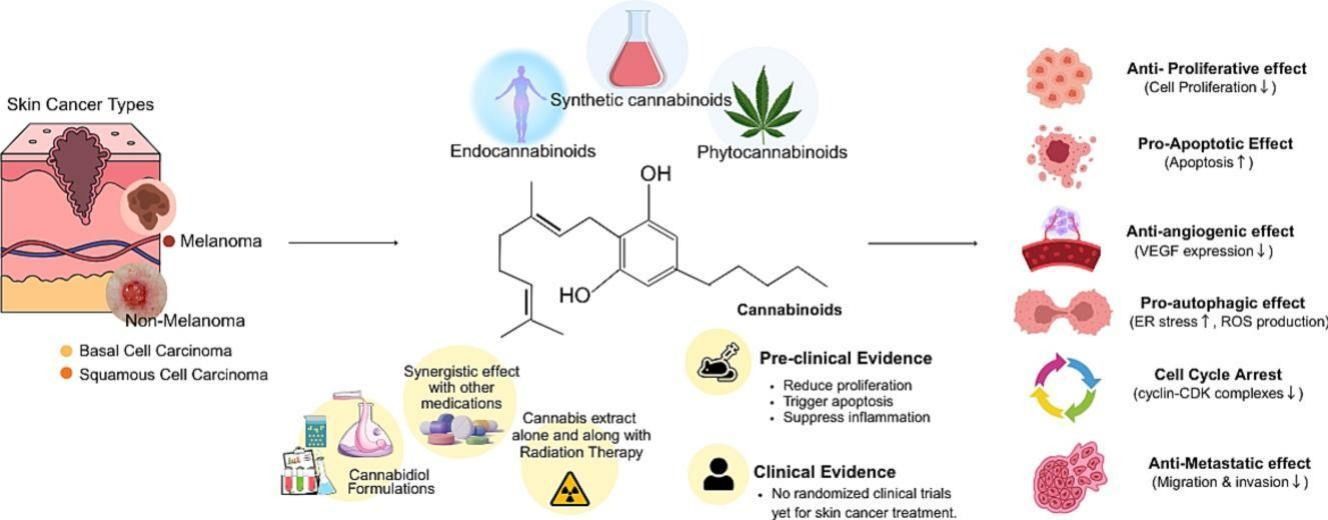
Skin cancer represents a significant global healthcare challenge, with rising incidence and persistent gaps in effective long-term management. Recent evidence has identified the endocannabinoid system as an emerging therapeutic target offering novel pharmacological approaches for the prevention and treatment of various skin cancers. Cannabinoids, through modulation of the endocannabinoid system, have demonstrated antitumor activity by inhibiting tumor proliferation, angiogenesis, invasion, and metastasis and by inducing apoptosis and autophagy in malignant cells. This review synthesizes the most recent preclinical evidence on phytocannabinoids, endocannabinoids, and synthetic cannabinoids in melanoma and non-melanoma skin cancers, delineating receptor-dependent and receptor-independent mechanisms. Additionally, emerging cannabinoid-based delivery strategies, particularly cannabidiol formulations designed to enhance skin penetration and therapeutic efficacy, are critically examined. Despite encouraging preclinical findings, clinical translation remains limited by scarce skin-cancer-specific trials, variability in cannabinoid preparations, and uncertainties around dosing and safety. Consequently, robust mechanistic studies and well-designed clinical trials are required to validate cannabinoids' therapeutic potential and guide their integration into future skin cancer treatment paradigms.
1. Introduction
Skin cancer represents a significant and growing global health challenge (Dachani et al., 2024); Yélamos et al., 2023; Wang et al., 2025. Skin cancers are primarily classified into non-melanoma skin cancers (NMSC), which include squamous cell carcinoma (SCC) and basal cell carcinoma (BCC), and melanoma skin cancer (MSC), which comprises cutaneous melanoma (CM). Collectively, these malignancies pose substantial morbidity and economic burden globally. Non-melanoma skin cancers, particularly BCC and SCC, account for the majority of skin cancer cases, with BCC alone comprising approximately 80% of NMSC diagnoses (Lopez et al., 2017). According to recent global data from GLOBOCAN (2022), NMSC was the 5th most common cancer in the world, with an estimated 1,234,533 cases diagnosed worldwide. Melanoma of the skin ranked as the 17th most common cancer at the time, accounting for an estimated 331,722 new cases. It is important to note that countries like Australia report significantly higher case numbers due to high UV exposure and the use of treatment-based reporting rather than population-wide registries. Despite regional differences in incidence, there is relatively little geographic variation in mortality rates. NMSC was responsible for about 69,416 fatalities. Melanoma, on the other hand, is much more aggressive despite being less common; it resulted in approximately 58,667 deaths worldwide. These figures highlight the high prevalence of skin cancer worldwide and the vital importance of early detection and treatment (Wang et al., 2025). Early detection strategies, including regular skin examinations using dermoscopy and reflectance confocal microscopy, and preventive measures such as public education on sun protection and minimizing exposure to risk factors (arsenic, radiation, immunosuppressants), remain vital in reducing morbidity and economic burden. The COVID-19 pandemic has further intensified these challenges, as delayed diagnoses have led to advanced disease stages and increased healthcare costs. Understanding the etiology, biology, epidemiology, and management strategies for skin cancer, along with the integration of genetic biomarkers for diagnosis and prognosis, is thus crucial for improved patient outcomes (Dachani et al., 2024; Yélamos et al., 2023; Lopez et al., 2017).
Melanoma development results from a complex interplay of genetic susceptibility and environmental factors, particularly ultraviolet radiation (UVR). Genetic alterations play a central role in melanoma pathogenesis, with approximately 90% of cases arising sporadically rather than through familial inheritance. Among these sporadic melanomas, activating mutations in BRAF are the most frequently observed. In contrast, familial melanomas, which account for roughly 10% of cases, are commonly associated with dysregulation of cell cycle regulatory pathways (Vuković et al., 2019). There is substantial evidence linking UVR exposure to NMSC. UV-A radiation penetrates deeper into the skin than UV-B radiation and induces oxidative stress, inflammation, immunosuppression, and indirect DNA damage through the generation of reactive oxygen species. In contrast, UV-B radiation causes direct DNA damage, primarily affecting keratinocytes within the epidermis. DNA is considered the primary photoreceptor for UVR, and one of the earliest molecular events following UV exposure is the formation of cyclobutane pyrimidine dimers, which contribute to immunosuppression and mutagenesis. UVR-induced mutations in the tumor suppressor gene p53, which normally regulates DNA repair or apoptosis of damaged cells, impair these protective mechanisms. Consequently, loss of effective p53 function promotes uncontrolled keratinocyte proliferation and disrupts apoptotic regulation, ultimately contributing to skin carcinogenesis (Dachani et al., 2024; Lopez et al., 2017).
Melanocytes respond to UVR by initiating melanogenesis, leading to increased melanin production and visible skin pigmentation. Melanin possesses photoprotective properties that help protect epidermal cells from UV-B–induced DNA damage. Consistent with this protective role, individuals with higher baseline melanin levels exhibit a lower incidence of skin cancer. Nevertheless, excessive or chronic UVR exposure remains a major risk factor for skin carcinogenesis, as it induces DNA damage, oxidative stress, and apoptosis, ultimately promoting malignant transformation. However, other significant contributors include arsenic exposure, radiotherapy, prolonged immunosuppression, and infection with human papillomavirus (HPV) (Dachani et al., 2024; Lopez et al., 2017). Recent research has illuminated multiple signaling pathways central to the pathogenesis of various skin cancers. In melanoma, pathways such as MAPK (mitogen-activated protein kinase), PI3K/PTEN/AKT (phosphatidylinositol 3-kinase/protein kinase B), and MITF (microphthalmia-associated transcription factor) play pivotal roles (Fig. 1) (Vuković et al., 2019). In SCC, disrupted pathways such as retinoblastoma protein (pRb), p53, and NOTCH are significant (Fig. 2) (Fania et al., 2021), whereas aberrant activation of the canonical and non-canonical Hedgehog (HH) pathways and other signaling cascades (e.g., WNT, Notch1, Hippo) prominently feature in BCC pathogenesis (Fig. 3) (Fania et al., 2020).
[...]